Let’s discuss something that can really take your site’s performance to the next level and enable you to make better decisions – A/B Testing.
Whether you have an ecommerce site, a blog, a saas business, or any other type of digital presence, your ultimate goal is probably the same getting users to take action.
That could be more people buying, signing up for a newsletter, subscribing to a service, or just clicking on a call to action button.
But how can you be sure what changes will actually make your results better? Should your button be red or blue? Should your headline be bold and snappy or simple or descriptive? This is where A/B Testing becomes your best friend.
By comparing variant versions of a webpage or component, you can find out what really speaks to your people.
In this post, we’re going to get into what A/B Testing is, why it works so well, and how you can implement it today to improve your website’s performance and drive the most conversions.
What Is A/B Testing? How to Use It to Optimize Your Website’s Conversion Rate
A/B testing, or split testing, is a process by which two versions of something (such as a webpage, app, or email) are compared to determine which one performs better according to certain metrics such as conversion rates or engagement.
It’s a method of making data-driven decisions trough testing variations and determining the best one.
It might be a small change, such as a call-to-action button color change. Or a bigger change, such as rewriting the headline on your homepage.
The principle here is to test one change at a time, track the effect, and make wiser decisions from real data not intution.
Why Should You Care?
Because every small change can lead to real growth.
Here’s the thing: You may think your “Buy Now” button is perfect in blue, but what if switching it to green increases your sales by 15%?
Without testing, you’d never know. A/B testing helps you:
- Improve user experience
- Boost conversion rates
- Decrease bounce rates
- Make data-driven decisions
What Can You A/B Test?
Just about everything that influences user behavior, like:
1. Headings and subheadings
These are usually the first thing people see when they arrive on your page, so they establish the tone for the whole user experience.
A fantastic headline can engage interest, but a poor one can send people away. It’s important that your headings and subheadings immediately convey what the page is about and get visitors to continue reading.
What to test: Wording, tone (formal or conversational), length, or format.
Why it matters: Effective, pertinent headlines have the ability to grab attention instantaneously abd copel users to read on.
Example:
A: “Boost Your Productivity with Our App”
B: “Get More Done in Less Time – Try Our App Today”
2. Call-to-action (CTA) buttons
CTAs are immediate commands to your users, leading them to the next step. A properly crafted CTA button doesn’t only draw eyes; it also unmistakably tells users what they’ll receive if they click on it.
What to test: Text (for example, “Buy Now” vs. “Get Started”), color, size, position, or shape.
Why it matters: A correctly optimized Call To Action can drive impressive click-throughs and conversions.
Example:
A: A green “Sign up free” button at the page bottom
B: A red “Try It Now” button near the top
3. Pictures or videos
Visuals have the ability to create an instant emotional connection with users, enabling them to grasp your product or service more effectively.
Users tend to react faster to images or videos compared to text, particularly in e-commerce or service based businesses.
What to test: Image type (product, lifestyle, illustration), video vs. static image usage, placement, or size.
Why it matters: The correct visuals can increase engagement and time on page.
Example:
A: A product demo video
B: A quality photo of the product being used
4. Page layout or navigation
The way a page is organized affects how users use it. A simple, intuitive design enhances usability, allowing users to more easily find what they’re searching for, which can lower bounce rates and increase conversion rates.
What to test: Navigation menu type, content sequence, sidebar usage, spacing, or scrolling behavior.
Why it matters: A better layout can lower bounce rates and enhance user flow.
Example:
A: Standard top navigation
B: Hamburger menu with dropdowns
5. Forms (length, fields, positioning)
Forms are an integral part of many sites, whether lead gen, sign-ups, or inquiries. But if designed poorly, forms make it hard to complete and result in increased abandonment.
Optimizing form experience is paramount.
What to test: Field number, field titles, input type, optional fields vs. mandatory fields, placement on the page.
Why it matters: Removing from friction can increase submission and lead generation rates.
Example:
A: A 10-field contact form
B: A 4-field quick inquiry form
6. Pricing or promotions
Pricing and special promotions are directly involved in the customer’s buying decision.
Subtle changes in how you present your pricing structure can have a significant impact on conversion rates.
What to test: Price levels, types of discount (percentage vs. dollar value), time sensitive offers, bundle choices.
Why it matters: Perceived value and sense of urgency can stiulate or discourage conversions.
Example:
A: $10/month
B: $100/year and receive 2 months free
7. Email subject lines
Your email’s subject line is the first impression your message makes on recipients. If the subject line fails to catch attention, your email may remain unread regardless of how good the content within it is.
What to test: Wording, personalization (e.g., recipient’s name), emojis, length, urgency.
Why it matters: Increased open rates result in increased clicks and conversions from emails campaigns.
Example:
A: “Your 20% Off Code Inside!”
B: “Hey Jack, Don’t Miss This Deal”
How to Run an A/B Testing

A/B testing can seem daunting, but with the right process and right tools, it’s unexpectedly easy.
Here’s a step-by-step guide:
Define Your Goal

Your objective must be specific, measurable, and aligned with your business or product KPIs. Don’t use ambiguous objectives such as “make the page better.” Instead, set a measurable goal.
Examples:
a) Get 15% more sign-ups for the newsletter in 2 weeks
b) Decrease cart abandonment by 10%
c) Get 20% more CTR on the main banner
Having a specific metric to measure against will make your test have direction and purpose.
Create a Hypothesis

Test a single element at a time in order to find out the effect of that one element. You may employ a hypothesis driven method.
This is your educated guess. You’re basically saying, “I believe changing X will result in Y.
Example:
“If we change the CTA text from ‘Buy Now’ to ‘Get Started’, more people will click the button”.
Build Your Variations
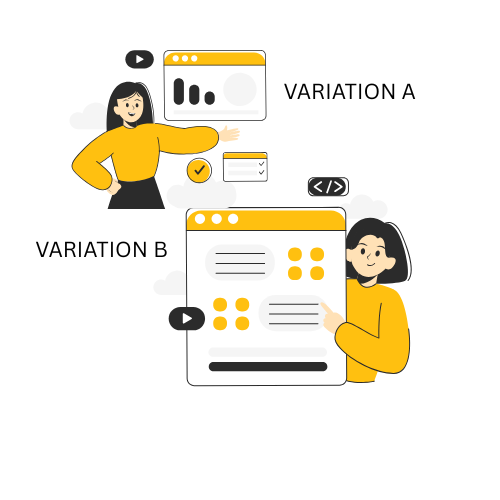
Develop Version A (control) and Version B (the variant). Keep all other variables constant.
Think small and focused:
- A different button color
- A shorter headline
- A more casual tone in your form copy
Tips:
- Test only one change at a time
- Keep the visual design and tone consistent unless that’s part of the test
- QA both versions to ensure functionality
Split Your Traffic

Split your traffic in half using a tool to randomly display visitors either version A or B. Maintain a 50/50 split.
Split Methods:
- Client-side tools (Google Optimize): Assign users to variants in their browser
- Server side testing: More secure, typically used for backend logic changes
- Email platforms: Tools like Mailchimp let you test subject lines, sending times, etc.
Run the Test

Run the test long enough to get good data (usually a minimum of a week, depending on traffic levels).
Analyze the Results

Which version met your goal better? Use tools like Google Optimize, Optimizely, or VWO to help analyze the numbers.
Ask yourself:
- Which version performed better?
- By how much?
- Are you confident in the result?
Take Action

If Version B wins, make it your new default. If not, you’ve learned what doesn’t work which is still valuable.
Pro Tips to Make the Most of A/B Testing
- Only try one change at a time. Otherwise, you won’t know what produced the result.
- Ensure your sample size is sufficiently large. More data = more credible insights.
- Be patient. Don’t declare a winner prematurely.
Key benefits of A/B testing:
- Data-Driven Decisions – A/B testing make informed choices based on real user behavior instead of guesswork.
- Improved Conversion Rates – Optimize elements to increase clicks, sign-ups, purchases, etc.
- Reduced Risk – Test changes before full rollout to avoid negative impacts.
- Better User Experience – Discover what resonates with users and streamline their journey.
- Higher Marketing ROI – Maximize results from campaigns without increasing ad spend.
- Deeper User Insights – A/b testing make you learn what motivates your audience and what turns them off.
- Validate Product Features – A/B testing allows Test new features or flows before launching widely.
- Supports Continuous Improvement – Enables small, consistent optimizations over time.
Why Choose JusTech Creations?

When you need the services of professionals to develop a WooCommerce website based on your company, JusTech Creations offers extensive solutions to suit your requirements.
Whether you select the best WooCommerce theme or get it customized to support your brand identity, JusTech Creations ensures a hassle-free website development process.
Professional Expertise: Their experts guide you to find the best theme suitable for your business purpose, be it for eCommerce, blog, portfolios, or corporate websites.
Speed and Optimization: They optimize for speed, keeping your site light and fast-loading, which improves user experience and search engine optimization.
Mobile Responsiveness: All designs are mobile responsive by default, providing a smooth browsing experience on all devices.
Plugin Compatibility: JusTech ensures your site is compatible with necessary plugins such as WooCommerce extensions, SEO plugins, and security plugins.
FAQ
Q: What tools can I use for A/B testing?
Ans: Popular A/B testing tools include: Google Optimize, Optimizely, VWO (Visual Website Optimizer), Unbounce, HubSpot.
Q: Can A/B testing be used for different marketing channels?
Ans: Yes, A/B testing can be applied across various channels, including email marketing, social media ads, and landing pages. Each channel may require slightly different approaches based on user behavior.
Q: How can I analyze A/B test results?
Ans: Analyze results by comparing key performance indicators (KPIs) between the two versions.
Final Thoughts
A/B testing isn’t reserved for data nerds or huge companies it’s for anyone who wants to get their website to do more.
It eliminates the guesswork, save times, and allows you to create a site that your audience actually reacts to.
So if you’re serious about increasing conversions, start A/B testing. Your next big success could be one small adjustment away.
If you have any questions regarding anything, do not hesitate just to comment below, and we will help you solve your problem. Thanks for reading this blog.
Do Follow us on Instagram and Linkedin.
Discover More Articles:
- How to Choose the Perfect WordPress Theme for Your Website
- Top Marketing Automation Tools for WordPress Users in 2025
from Justech Creations https://ift.tt/e4Ew1dX





